06 July 2009
Make the math
From everything I could read on the net about Michael Jackson since he died, nothing felt as touching and sounded so fair than the All Music blog tribute written by Stephen Thomas Erlewine. When I watch countless You Tube videos showing people all over the world dancing in the streets to the sound of 'Billie Jean' or of 'Don't stop till you get enough', I can only relate, because like everyone else my shoes grow wings as I hear those tracks, there's no way to resist the temptation. Which is exactly why in any party I've been to or hosted, you couldn't get people on the dancefloor - especially the ones that linger on forever in the kitchen - before you inevitably resolved to play an MJ or a Jackson 5 classic. And only then could you think of leading the crowd to a maybe more adventurous pick. It's like a magic trick. The only time in my life when I didn't use it was when my friends and I were having a post-adolescence dismissal of anything mainstream - so of course our signal song for kicking-off the dancing time would be 'Smells like teen spirit'... before its tiny acknowledgment beyond our circle (then) made it even too mainstream for us (this from a girl whose favorite band ever is The Beatles)...
Well it's been a while I don't care about being mainstream - at least regarding music. I actually find it pretty comforting to feel the same mix of sadness, nostalgia and musical bliss as millions of people. Not only do we keep listening everywhere for groovy and hyper emotional music since ten days, but we listen to it "together". That must be the closest I've been to a true religion experience.
Which brings me back to the All Music tribute and its last paragraph : "But Michael Jackson was never meant to be a cult artist, which is one of the many reasons his music of the last two decades often struck a dissonant chord: he belonged to the masses, providing a soundtrack to billions of people around the world, from the millions that made Thriller the biggest album ever to those who never owned one of his records and yet knew all his hits. That is the Michael Jackson that has been absent for 20 years and that is the Michael Jackson that is being mourned today. His sudden death gives us all an opportunity to appreciate the enduring genius of his art but to realize that we have no musician that speaks to all of us … and that we haven’t for some time now."
Michael Jackson or the last common music denominator.
--Joëlle
Well it's been a while I don't care about being mainstream - at least regarding music. I actually find it pretty comforting to feel the same mix of sadness, nostalgia and musical bliss as millions of people. Not only do we keep listening everywhere for groovy and hyper emotional music since ten days, but we listen to it "together". That must be the closest I've been to a true religion experience.
Which brings me back to the All Music tribute and its last paragraph : "But Michael Jackson was never meant to be a cult artist, which is one of the many reasons his music of the last two decades often struck a dissonant chord: he belonged to the masses, providing a soundtrack to billions of people around the world, from the millions that made Thriller the biggest album ever to those who never owned one of his records and yet knew all his hits. That is the Michael Jackson that has been absent for 20 years and that is the Michael Jackson that is being mourned today. His sudden death gives us all an opportunity to appreciate the enduring genius of his art but to realize that we have no musician that speaks to all of us … and that we haven’t for some time now."
Michael Jackson or the last common music denominator.
--Joëlle
Labels: dancefloor, Michael Jackson, Music, party


08 April 2009
High-school hype
The French newspaper Le Figaro just released a ranking of the best high-schools in France. Turns out my old one, the Lycée Victor Hugo, is ranked 1st public school in the academy of Paris (2 private schools are ahead)! It's ranked 25th in France over 1915 (but most of the top ones are again private schools so it makes my high-school one of the best public school in France). It came a long way, baby so I'm rather pleased. When I attended the school between 1990 and 1993, it was rather average. There were a couple of amazing teachers, like my 1st Russian teacher, but overall none of them made a real positive impression (on the contrary, we had rather really terrible History and English teachers), while the impact my teachers from Junior high made on me is still fresh and enjoyable.
That said, the place itself was a cool stir of people : I got to meet there life-changing friends, I discovered with them and thanks to them some of the best music ever, like Nirvana, Faith no more, Pulp, Nick Cave, Sonic Youth among others (and we went to see all of the above in concert). We weren't hype by the then standards (although we would be very hype now), we were a group of music and pop-culture geeks, we hated being teenagers but we did love each other very much (and also argued with each other a lot a lot).
-- Joëlle.
That said, the place itself was a cool stir of people : I got to meet there life-changing friends, I discovered with them and thanks to them some of the best music ever, like Nirvana, Faith no more, Pulp, Nick Cave, Sonic Youth among others (and we went to see all of the above in concert). We weren't hype by the then standards (although we would be very hype now), we were a group of music and pop-culture geeks, we hated being teenagers but we did love each other very much (and also argued with each other a lot a lot).
-- Joëlle.
Labels: Faith no more, geeks, High-school, Le Figaro, Lycée Victor Hugo, Music, Nick Cave, Nirvana, Pop Culture, Pulp, Sonic Youth
03 February 2009
People for people
Seen on the french geek blog Transnets today: a video seen more than 5 million times on YouTube! It's the song Stand by Me, sung by street musicians all over the world and mixed together in one video by Playing for change. I don't know if it was the specific intention (the said one is "to bring peace through music") but for me it's a very simple and effective way to bring awareness to the people all over the world who earn some of their living with playing in the streets and give them a deserving homage.
Labels: Awareness, Connection, Distance, Music, Video
17 March 2008
Lost word
Last week, I went to see the new Gondry's masterpiece, Be Kind, Rewind. In all of his works, what strikes me the most is the brightness of his ideas, of his imagination. In that particular movie, I was touched by his reading of the (hi)story of cinema and of popular culture. But moreover, he subtly demonstrates how we need fiction to function, how we create narratives to make sense of reality and how we tell each other stories in order to connect, to live together (as in a polis) and to get a sense of belonging to a community/a family.
While I was watching the movie, I thought on another brilliant inventor, John Cage. I was then reading a book of conversations between Cage and Daniel Charles, called "Pour les Oiseaux" / "For the Birds" (a wordplay around the birdcage). What got me to think of him was a word that came back often in Gondry's movie: "sueded". In Be Kind, Rewind, the owners of a video club are shooting their own versions of movies like Ghostbusters, 2001, A Space Odyssey, Rush Hour 2, Boyz in the Hood and many more. They qualify their "remakes" as "sueded" because, as they explain, the tapes are "imported from Sweden". In an interview for the LA Times, Gondry said he "wanted a name that meant nothing". And from that he created a verb that means re-doing/re-interpreting/re-creating/re-composing just about anything, including webpages (in the movie's official site, you can find samples of Goolge and MyFace).
But the thing is what are the chances of coming across a word that doesn't exist twice in a week in 2 different contexts? In For the Birds, Cage uses that exact same word in its French verb form "suédé". So of course, after the movie, I go back home and start browsing the book in search of the paragraph, to compare the 2 meanings. But I browsed it again and again, 4 or 5 times, but I lost it. I can't find that word again. I thought for a bit that I dreamed it, that it's all a mix in my head, a Cage-Gondry conspiracy. But I'm convinced I did read it, because I remember thinking what the hell is that word "suédé"? what's the concept behind it? Maybe one day, when there's a digital copy of the book, it'll be easier to look into it. For now, I prefer to play around more obvious concepts addressed all over the book: silence, nothing, void, space, ecology, technology, references to Thoreau, Fishinger and Backminster Fueller..
In a last associated thought (who said again that the brain functions with associations?), reading Cage made me think about a wonderful project that Cati blogged about: "OTTO" created by Duncan Wilson and Manolis Kelaidis at the Royal College of Art.
An excerpt of the description: "OTTO (Greek for ‘ear’) is a device that makes hidden sounds audible. (...) Every object and surface in our environment has a whisper; subtle tremors and vibrations that are usually undetectable to the human ear, produced by the activity and movement of daily life. What if these sounds were audible? How would that change our aural awareness, perception of space and attitude towards objects? Would it be possible to ‘compose’ our own soundtrack using our walls and objects as a new form of instruments?"
For me this is more or less achieving as a standalone technology what Cage elaborated in his theories and his compositions: a way for us to hear the silence, the sound of objects, of our environment and make a sense of it: being an audience and a composer at the same time.


-- Joëlle.
While I was watching the movie, I thought on another brilliant inventor, John Cage. I was then reading a book of conversations between Cage and Daniel Charles, called "Pour les Oiseaux" / "For the Birds" (a wordplay around the birdcage). What got me to think of him was a word that came back often in Gondry's movie: "sueded". In Be Kind, Rewind, the owners of a video club are shooting their own versions of movies like Ghostbusters, 2001, A Space Odyssey, Rush Hour 2, Boyz in the Hood and many more. They qualify their "remakes" as "sueded" because, as they explain, the tapes are "imported from Sweden". In an interview for the LA Times, Gondry said he "wanted a name that meant nothing". And from that he created a verb that means re-doing/re-interpreting/re-creating/re-composing just about anything, including webpages (in the movie's official site, you can find samples of Goolge and MyFace).
But the thing is what are the chances of coming across a word that doesn't exist twice in a week in 2 different contexts? In For the Birds, Cage uses that exact same word in its French verb form "suédé". So of course, after the movie, I go back home and start browsing the book in search of the paragraph, to compare the 2 meanings. But I browsed it again and again, 4 or 5 times, but I lost it. I can't find that word again. I thought for a bit that I dreamed it, that it's all a mix in my head, a Cage-Gondry conspiracy. But I'm convinced I did read it, because I remember thinking what the hell is that word "suédé"? what's the concept behind it? Maybe one day, when there's a digital copy of the book, it'll be easier to look into it. For now, I prefer to play around more obvious concepts addressed all over the book: silence, nothing, void, space, ecology, technology, references to Thoreau, Fishinger and Backminster Fueller..
In a last associated thought (who said again that the brain functions with associations?), reading Cage made me think about a wonderful project that Cati blogged about: "OTTO" created by Duncan Wilson and Manolis Kelaidis at the Royal College of Art.
An excerpt of the description: "OTTO (Greek for ‘ear’) is a device that makes hidden sounds audible. (...) Every object and surface in our environment has a whisper; subtle tremors and vibrations that are usually undetectable to the human ear, produced by the activity and movement of daily life. What if these sounds were audible? How would that change our aural awareness, perception of space and attitude towards objects? Would it be possible to ‘compose’ our own soundtrack using our walls and objects as a new form of instruments?"
For me this is more or less achieving as a standalone technology what Cage elaborated in his theories and his compositions: a way for us to hear the silence, the sound of objects, of our environment and make a sense of it: being an audience and a composer at the same time.
-- Joëlle.
Labels: Be Kind, cinema, John Cage, Michel Gondry, Music, OTTO, Rewind, Sueded, Suédé, technology
09 December 2007
33 and 1/3
Last day, I was walking home and I was thinking about being 33 soon, and what to do for my birthday. And then my mind wandered around the number 33, as I remembered the George Harrison album called Thirty-Three and 1/3. That's probably as I made that connection that I understood what I wanted for my birthday: music in the forms of LPs. So, I sent an email to my friends asking them to send or bring with them an LP of a band or an artist that have been important in their lives. And during my birthday party, I would play a song from the album of their choices.
Today, I also noticed that Harrison released 33 and 1/3 in 1976, he was 33 then... I probably knew about that fact when I was 14 or something but then I was probably not very sensitive to it, until now.. like an LP, what comes around goes around.
My favorite song from this album is undoubtedly Crackerbox Palace.
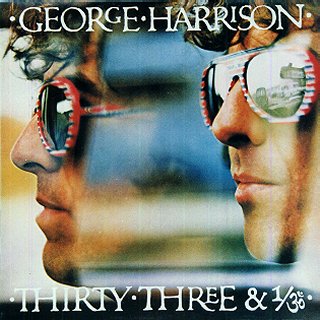
Today, I also noticed that Harrison released 33 and 1/3 in 1976, he was 33 then... I probably knew about that fact when I was 14 or something but then I was probably not very sensitive to it, until now.. like an LP, what comes around goes around.
My favorite song from this album is undoubtedly Crackerbox Palace.
Labels: Birthday, George Harrison, Music
03 December 2007
Quel est donc ce froid que l'on sent en toi?
Months ago, I had thought of blogging about this video. And then I forgot. And then last week, I remembered.
It's one of the most famous French-produced music video, when the genre blossomed in the mid-eighties. Since 1985, "Marcia Baïla" by les Rita Mitsouko is a song that have made people danced wild in most home parties - it's a bit like Billie Jean, in that it never fails to get people on the dance-floor even when everybody is lingering on in the kitchen, trying to re-invent the world in conversations. It's "the" party song, full of life, of energy, of freedom and yet, it talks about... death and cancer (of the dancer Marcia Moretto). It's probably also one of 1st example in France when the success of a song is not only due to the lyrics and the music but also to the video. Directed by a young creative talent at the time, Philippe Gautier, it soon became the reference. He incorporated influences from other art disciplines: dance (flamenco and modern jazz), painting and performance. 8 graphic artists were involved (Richard Beaudemont, Nina Childress, Jeff Gravis, Anne-Iris Guyonnet, Ricardo Mosner, Sam Ringer, Xavier Veilhan, William Wilson). And of course, costumes were designed by newcomers Jean-Paul Gaultier and Thierry Mugler. When the music TV channel, TV6 started to broadcast in 1986, it was one of the most popular videos. And every time I watch it now, I see myself as a kid in front of the TV, dancing to it, trying to follow the surreal movements of singer Catherine Ringer. My mum regards the song as one of her favorite, ever. In regards to music, it was also very different from the usual french pop, actually I'm not even sure there was anything such as french pop... Les Rita Mitsouko managed to bring to a bewildered mass audience a concentrate of indie and pop from the UK and the States.
We have the music video as a trace of that time as it truly epitomizes the eighties extravaganza in France, and let's not forget the simple pleasure of watching and listening to it. It still is in every way modern.
Fred Chichin, the composer and guitar player, half of les Rita Mitsouko, died last week of cancer at 53. I love his George Harrison look-and-feel in the video.
It's one of the most famous French-produced music video, when the genre blossomed in the mid-eighties. Since 1985, "Marcia Baïla" by les Rita Mitsouko is a song that have made people danced wild in most home parties - it's a bit like Billie Jean, in that it never fails to get people on the dance-floor even when everybody is lingering on in the kitchen, trying to re-invent the world in conversations. It's "the" party song, full of life, of energy, of freedom and yet, it talks about... death and cancer (of the dancer Marcia Moretto). It's probably also one of 1st example in France when the success of a song is not only due to the lyrics and the music but also to the video. Directed by a young creative talent at the time, Philippe Gautier, it soon became the reference. He incorporated influences from other art disciplines: dance (flamenco and modern jazz), painting and performance. 8 graphic artists were involved (Richard Beaudemont, Nina Childress, Jeff Gravis, Anne-Iris Guyonnet, Ricardo Mosner, Sam Ringer, Xavier Veilhan, William Wilson). And of course, costumes were designed by newcomers Jean-Paul Gaultier and Thierry Mugler. When the music TV channel, TV6 started to broadcast in 1986, it was one of the most popular videos. And every time I watch it now, I see myself as a kid in front of the TV, dancing to it, trying to follow the surreal movements of singer Catherine Ringer. My mum regards the song as one of her favorite, ever. In regards to music, it was also very different from the usual french pop, actually I'm not even sure there was anything such as french pop... Les Rita Mitsouko managed to bring to a bewildered mass audience a concentrate of indie and pop from the UK and the States.
We have the music video as a trace of that time as it truly epitomizes the eighties extravaganza in France, and let's not forget the simple pleasure of watching and listening to it. It still is in every way modern.
Fred Chichin, the composer and guitar player, half of les Rita Mitsouko, died last week of cancer at 53. I love his George Harrison look-and-feel in the video.
Labels: Marcia Baila, Music, Philippe Gautier, Rita Mitsouko, Video
11 November 2007
"The biggest twat in Manchester...
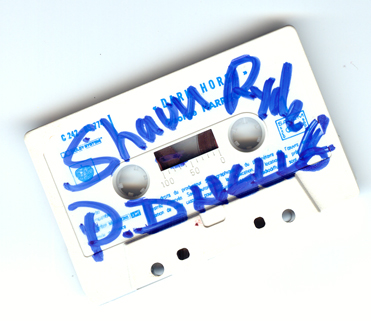
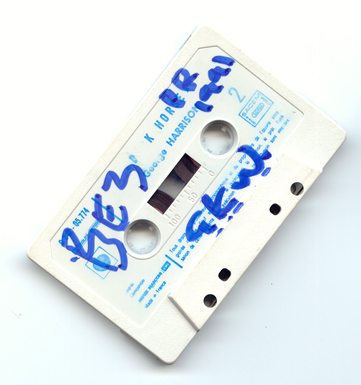
being played by the second biggest twat in Manchester” is what Peter Hook, New Order’s bassist, said, commenting on Steve Coogan’s casting as Tony Wilson in 24-hour Party People. Claire told me yesterday Wilson had died last summer - news travel very fast nowadays... It came up as we were wondering how it was possible the Happy Mondays survived from all the drug intake - they played this week at Festival des Inrocks in Paris. I remember when I saw them by chance like 15 or 16 years ago at a signing in the Champs-Elysée Virgin Megastore, I didn't have money to buy their records then but I had a George Harrison tape with me which all the band members signed, incredulous and amused at the object. Soon after, I got the "Pills, thrills and bellyaches" CD for free, as I called Barclay, the french label distributor, and told them I wanted to make a review for a school magazine we were editing in our high-school. Lisa, Cécile, Sophie L. and Sophie F. and I called the magazine "Fulbert" - we made 2 editions in total, wrote articles with hidden names and it had a little success of its own. Tony Wilson's death makes me think about the current music industry and how it is so far away from the way he dealt with his own label, Factory or the bands he helped (Joy Division, New Order, Happy Mondays) plus all the DJ's he put forward at the Hacienda, the club he opened as a way "to give back to the people". He was maybe a twat indeed, and a desastrous money manager but he made more things for the music than all the current label managers will ever dream to do, just out of passion and pleasure. If all the music industry is interested in at the moment is to find how to keep on cashing on all the rights that are being lost to downloading, then it's for sure going to die. But I'm not convinced it's a wrong thing after all.
Labels: Happy Mondays, High-school, Music, Tony Wilson
20 October 2007
Music for the global warming
Radioz is a small online community of friends who are each publishing every now and then a music playlist, powered by the friendly Zanorg radio system, that can be added to any website. For his 11th playlist, David invited me to participate and share the tracks selection.
To celebrate the sweet and savoury flavours of the autumn season, we prepared a 17-tracks playlist that follow on from each other, as one track answers the temptations of the previous one. The first proposal is mine, then David's reply provokes a chain reaction...
You can listen to the songs separately or - even better - as one track (mixed more or less as in a radio station) by selecting "Mix radioz 11" at the end of the tracklisting (it takes a bit longer to load).
The playlist is available as you pick "David" (1st name on the list) from the radioz homepage.
Enjoy!
--Joëlle.
To celebrate the sweet and savoury flavours of the autumn season, we prepared a 17-tracks playlist that follow on from each other, as one track answers the temptations of the previous one. The first proposal is mine, then David's reply provokes a chain reaction...
You can listen to the songs separately or - even better - as one track (mixed more or less as in a radio station) by selecting "Mix radioz 11" at the end of the tracklisting (it takes a bit longer to load).
The playlist is available as you pick "David" (1st name on the list) from the radioz homepage.
Enjoy!
--Joëlle.
Labels: Music, Playlist, Radio
18 June 2007
Daft Punk at Rock Ness 2007
It was as good as you'd imagine it would be... No, wait... better!


--Joëlle
--Joëlle
Labels: Daft Punk, Music, Rock Ness
01 June 2007
Beatles Moments
What is a Beatles moment?
It's when something said, sung, played, shouted, staged (etc..) in a Beatles song catches the attention and sticks in the memory. For instance, one of my favorite is in the "A Day in the Life" bridge, the "ha, ha, ha" groan after Paul says "I noticed I was late" and then few lines later the way he pronounces "Found my way uptairs and had a SMOKE, and somebody SPOKE and I went into a dream". I heard the song, what?, hundreds of time, and I still get the chill when I catch those moments.
Apparently, I'm not the only one. I discovered this blog post through Le Monde website and its part 2. The writer made a .mp3 for a selection of these moments. He followed what seems like an exciting musicology seminar called "The Music of the Beatles", run by Pr. Gass at IU Music School who likes to think in terms of "Beatle moments".
I share many of his favorites and it gave me the opportunity to listen to the outputs with a spotlight on because isolated from the rest of the song. It's a different way to notice the extraordinary quality of all the elements that got into place in their compositions, from voice, to guitar, to intro, drums, transitions, pronunciations, etc..
Killer moments for me: When Paul says "Limousine" in "Your never give me your money", it breaks my heart. And the Marathonpacks blogger is right, his "You and I have memories, longer than the road that stretches out ahead" in "Two of Us" addressed to John is a tearjecker. Also, the way John sings in a chain the verses of "Across the Universe" without taking a moment of breath, the "Tum-Tum" of Ringo in "Every Little Things", the guitar intro of "I've Just Seen A Face", the "IRRRam in love with you" of George in "Do you want to know in secret?" with his delicious L'pool accent, not even 20 years old and still nervously mimicking somewhat John but clearly learning fast to be himself...
Today, Sgt Pepper's is 40. Which is why many articles are spreading around of course to write about how it's overestimated, underestimated, the Peter Blake's album cover, the LSD, the 1st concept album like it was planned to be so and what not: too many clichés to actually learn anything interesting.
I just remember that 20 years ago today, Sgt Pepper's was 20. And I was 12. This is about when I got seriously hooked up on the band. I have in mind a great documentary I saw on TV around then that I was lucky to tape on VHS: "It was twenty years ago today", a pertinent and definitive analysis of the album - and its repercussions, offering a take on each song. Many people who worked on the album, including no less than George Harrison and Paul McCartney, talk about it. But also, we hear comments by notorious contemporary audience. In particular, watch for Allen Ginsberg's analysis of "She's Leaving Home".
-- Joëlle
It's when something said, sung, played, shouted, staged (etc..) in a Beatles song catches the attention and sticks in the memory. For instance, one of my favorite is in the "A Day in the Life" bridge, the "ha, ha, ha" groan after Paul says "I noticed I was late" and then few lines later the way he pronounces "Found my way uptairs and had a SMOKE, and somebody SPOKE and I went into a dream". I heard the song, what?, hundreds of time, and I still get the chill when I catch those moments.
Apparently, I'm not the only one. I discovered this blog post through Le Monde website and its part 2. The writer made a .mp3 for a selection of these moments. He followed what seems like an exciting musicology seminar called "The Music of the Beatles", run by Pr. Gass at IU Music School who likes to think in terms of "Beatle moments".
I share many of his favorites and it gave me the opportunity to listen to the outputs with a spotlight on because isolated from the rest of the song. It's a different way to notice the extraordinary quality of all the elements that got into place in their compositions, from voice, to guitar, to intro, drums, transitions, pronunciations, etc..
Killer moments for me: When Paul says "Limousine" in "Your never give me your money", it breaks my heart. And the Marathonpacks blogger is right, his "You and I have memories, longer than the road that stretches out ahead" in "Two of Us" addressed to John is a tearjecker. Also, the way John sings in a chain the verses of "Across the Universe" without taking a moment of breath, the "Tum-Tum" of Ringo in "Every Little Things", the guitar intro of "I've Just Seen A Face", the "IRRRam in love with you" of George in "Do you want to know in secret?" with his delicious L'pool accent, not even 20 years old and still nervously mimicking somewhat John but clearly learning fast to be himself...
Today, Sgt Pepper's is 40. Which is why many articles are spreading around of course to write about how it's overestimated, underestimated, the Peter Blake's album cover, the LSD, the 1st concept album like it was planned to be so and what not: too many clichés to actually learn anything interesting.
I just remember that 20 years ago today, Sgt Pepper's was 20. And I was 12. This is about when I got seriously hooked up on the band. I have in mind a great documentary I saw on TV around then that I was lucky to tape on VHS: "It was twenty years ago today", a pertinent and definitive analysis of the album - and its repercussions, offering a take on each song. Many people who worked on the album, including no less than George Harrison and Paul McCartney, talk about it. But also, we hear comments by notorious contemporary audience. In particular, watch for Allen Ginsberg's analysis of "She's Leaving Home".
-- Joëlle
Labels: Beatles, Music, Pop Culture, Sgt. Pepper.

